I call them Nudes
for mixed chamber orchestra (2025)
Ensemble: Flute | Clarinet in Bb | Contrabassoon | Laptop| Three Synths | Two Violins | Viola | Cello
Composer Notes:I call them Nudes is a creative dialogue with Anne Carson’s The Glass Essay (1995), drawing its inspiration from poetry, visual artwork, and music. It does not set Carson’s text to music nor does it attempt to recreate its narrative. Instead, the piece is a contemplation on her idea of “Nudes”: fleeting, intimate portraits wherein body and mind become one. These are not depictions of nudity, but moments of perception—where the self is encountered through, and as, the body.
Following phenomenological thought (which Carson often references in her works), the body perceives the world while simultaneously becoming an object within it, as illustrated by Maurice Merleau-Ponty and Sarah Ahmed. In Nudes, the body exists simultaneously as perceiver and perceived, manifesting through fragmented spectral timbres and unstable rhythms that transform listening from a passive act into an immersive perceptual field, much like how a chair in my poem becomes both a mundane object and a vessel for deeper contemplation.
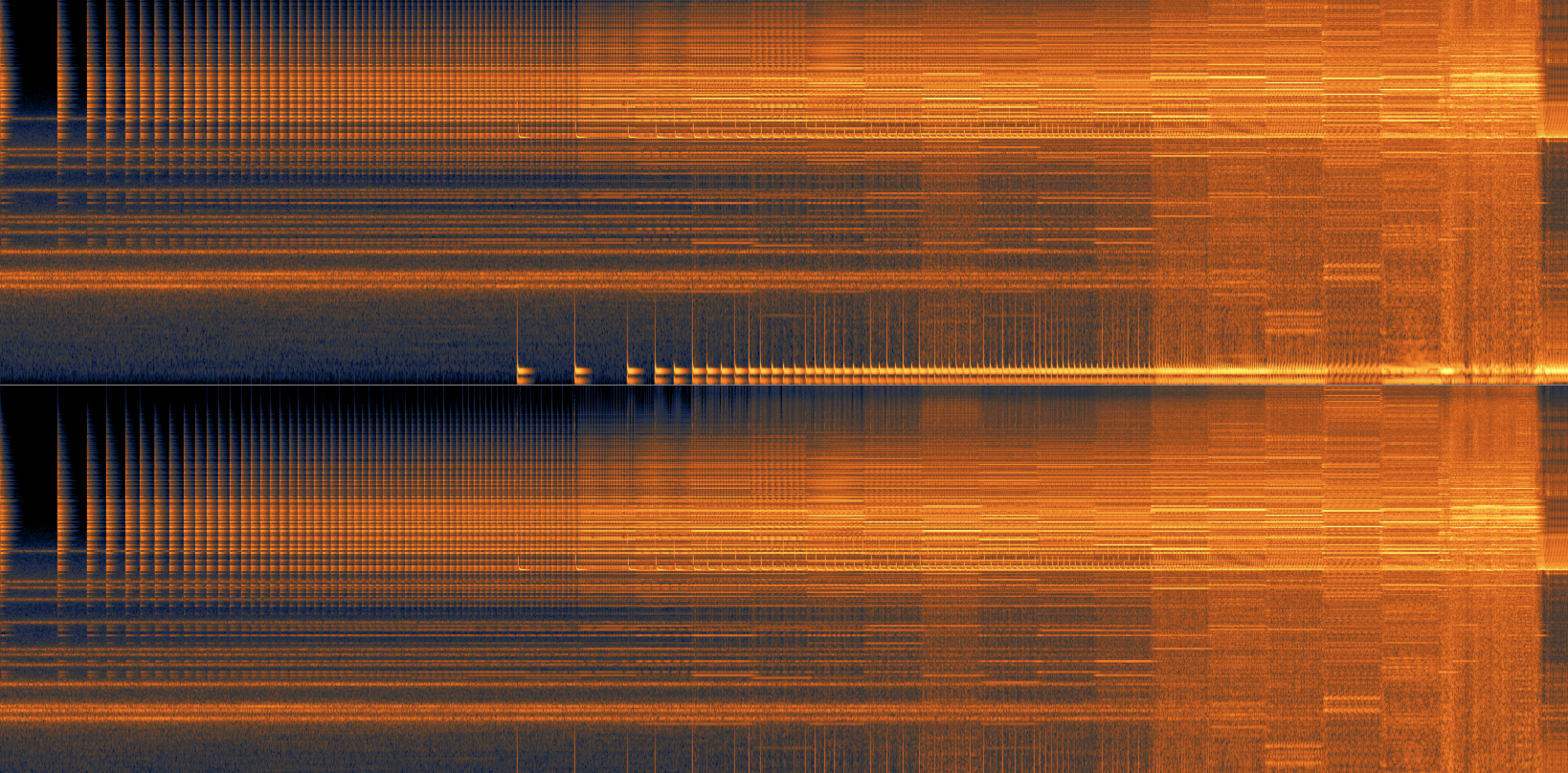
Spectral harmony, text-to-MIDI conversion, and rhythmic excess are the three main techniques explored in Nudes. Spectral music—music derived from the natural harmonic series—is used as raw material that is then broken up, destabilized. This parallels Carson's writing style. I utilized text-to-MIDI conversion tools (i.e., converting images of text to MIDI) to transform elements from my poem, Carson’s poem, and visual artworks into musical passages, which I then deconstructed into fragmentary musical ideas. Rhythm, meanwhile, operates as a kind of structural excess. A single highly dense polyrhythmic passage (1:11:111) presents a perceptual vertigo—a complexity too complex to interiorize. This is the point at which the technological apparatus is expressive not in control but in breakdown. The music stutters, overreaches, and collapses: the program crashes.
Through my interpretative lens on Carson’s The Glass Essay, I engage with both her “Nude #1” and “Nude #11” and my own, “Nude #111” and “Nude #1111,” creating an intimate dialogue between her poetry and artistic language. My compositional approach invites listeners to participates in their own process of self-reflection, as the Nudes serve as mirrors. Mirrors that reveal deep truths about identity, embodiment, and self-perception.